

Strength Training for Beginners at Home: 3 Workouts a Week with No Equipment
If you’re new to strength training, the hardest part is often not motivation—it’s knowing what to do, how long to do it, and how to make it harder over time without buying kit. This simple three-day plan uses only bodyweight, fits into 25–35 minutes per session, and builds a clear routine you can repeat week after week while gradually improving technique, strength, and confidence.
How the 3-day week works (and how to keep it beginner-friendly)
Train three non-consecutive days—Monday/Wednesday/Friday is the classic option, but any pattern with a rest day between sessions works. The sessions are labelled A, B, and C, and you repeat them in order. If your week gets messy, don’t “make up” missed workouts by doubling up; just do the next session when you can and keep the rest day rule.
Each workout is built around a short warm-up, two main circuits, and a brief finisher. You’ll move with control, stop a couple of reps before failure, and aim for clean form rather than chasing exhaustion. A useful guideline is the “two reps in reserve” rule: finish each set feeling like you could do two more good reps if you absolutely had to.
Time-saving setup matters at home. Pick one clear area, wear shoes if you need ankle and knee stability, and use a towel or folded blanket for kneeling moves. Keep a notebook note with the date, the variation you used (for example, incline press-up versus full press-up), and your reps—progress is much easier when you can see what you did last time.
Workout A (push + squat focus): 25–35 minutes
Warm-up (5–6 minutes): 30 seconds each of brisk marching, arm circles, hip hinges, bodyweight squats to a chair, and shoulder blade squeezes; repeat once. Then do 6 slow “practice reps” each of squat and press-up in your easiest version to groove the movement.
Main Circuit 1 (12 minutes, repeat 3 rounds, rest 30–45 seconds as needed): 1) Squat to chair or controlled bodyweight squat (8–12 reps), 2) Incline press-up on a table/sofa or full press-up (6–10 reps), 3) Glute bridge (10–15 reps). Move steadily, keep your ribs down, and focus on smooth reps rather than speed.
Main Circuit 2 + finisher (8–12 minutes): Circuit 2, 2 rounds: 1) Reverse lunge to a small range (6–8 per side) or split squat holding a doorframe for balance, 2) Pike shoulder tap or wall-supported pike hold (20–30 seconds), 3) Dead bug (6–10 per side). Finisher (2–3 minutes): wall sit (2 x 20–40 seconds) with 30 seconds rest. If your knees complain, shorten the range and slow down rather than pushing through sharp pain.
Training B: hinge + pull pattern without weights
Most home plans overdo pushing and squats and forget the “pull” pattern that helps posture and shoulder health. Without equipment, you can still train pulling muscles using isometrics (hard holds), slow eccentrics (slow lowering), and leverage-based rows using a sturdy table edge or a towel technique. The goal is not to mimic a gym perfectly—it’s to strengthen your upper back so pressing and daily posture feel better.
For the hinge pattern (the movement behind picking things up safely), beginners often bend the spine instead of hinging at the hips. In this session, you’ll practise a clean hip hinge and build strong glutes and hamstrings with variations that don’t require dumbbells. You should feel the work in the back of the legs and glutes, not as pressure in the lower back.
Intensity should feel “challenging but tidy”. If your form collapses—shoulders shrugging to your ears, knees caving in, or your lower back taking over—scale the move and keep the reps smooth. Progress comes faster when your technique improves, because you’ll be able to add volume safely in later weeks.
Workout B (hinge + back + core): 25–35 minutes
Warm-up (5–6 minutes): hip hinges with hands on thighs (10 slow reps), cat-camel (6 slow reps), standing “W” pulls (10 reps), and calf raises (15 reps). Then do one easy practice round: 5 hinges, 5 scapular press-ups (just shoulder blades), and 10-second plank.
Main Circuit 1 (12–14 minutes, 3 rounds): 1) Hip hinge good morning (10–12 reps, slow 3 seconds down), 2) Table row (6–10 reps) if safe, or towel row isometric (pull a towel against your thigh and hold 15–25 seconds per side), 3) Side plank (15–30 seconds per side). Keep your neck long and shoulders away from your ears during rows and planks.
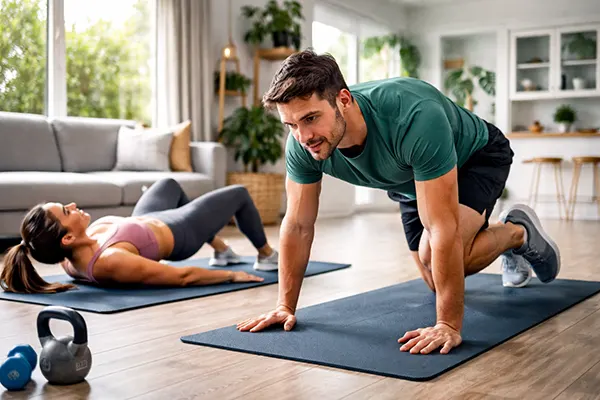
Main Circuit 2 + finisher (8–12 minutes): Circuit 2, 2 rounds: 1) Single-leg glute bridge (6–10 per side) or two-leg bridge with a 2-second squeeze at the top, 2) Prone “Y-T” raises (6–8 of each shape, slow and controlled), 3) Bird dog (6–10 per side with a 2-second hold). Finisher (2–3 minutes): suitcase carry without weight—walk slowly while keeping one arm “heavy” at your side and your torso tall (45 seconds per side, repeat once). It looks simple, but it teaches core bracing and posture.
4-week progression and how to fit training around a workday
This plan uses progression you can do without adding weight: more total quality reps, slightly harder variations, slower tempo, longer holds, and shorter rest. The key is to change only one “difficulty dial” at a time. If you change everything at once—harder moves, more reps, less rest—your joints usually complain before your muscles adapt.
Week 1 is your baseline: pick variations you can do with clean form. Week 2 adds a small amount of volume (typically one extra rep per set, or one extra round in one circuit). Week 3 increases difficulty by leverage or tempo (for example, lower the press-up more slowly, or pause for one second at the bottom of the squat). Week 4 is a consolidation week: keep the harder variation, but reduce total volume slightly so your body absorbs the work.
To combine this with microbreaks during the workday, think “grease the groove”, not “another workout”. Two to four times a day, take 60–90 seconds: stand up, walk, do 6–10 bodyweight squats to a chair, 8–12 calf raises, and 6 shoulder blade squeezes. These mini-moves keep hips and upper back from stiffening, reduce the urge to cram all movement into your evening session, and they shouldn’t leave you fatigued for your main training days.
Technique and joint safety (knees, lower back, shoulders)
Knees: discomfort often comes from letting the knees collapse inwards or from dropping too fast. Think “tripod foot” (big toe, little toe, heel on the floor), move slowly, and let the knee track roughly in line with the middle toes. If lunges feel cranky, shorten the step, reduce the depth, or use a split squat with a light hand on a wall for balance. Sharp pain is a stop signal; mild muscle burn is normal.
Lower back: most issues come from losing control in the hinge and trying to “reach” for depth with the spine. Practise the hinge by pushing your hips back like you’re closing a car door, keeping your ribs down and spine long. In bridges and planks, brace as if you’re about to cough, then breathe normally—holding your breath often makes form worse. If you feel pressure in the lower back during bridges, bring your feet a bit closer and focus on a strong glute squeeze.
Shoulders: pressing should feel stable, not pinchy. Use an incline for press-ups if your shoulders or wrists complain, and keep elbows at roughly a 30–45 degree angle from your body (not flared straight out). For overhead work, prioritise control: pike holds and shoulder taps should be pain-free and steady. If you sit at a desk, the row and “Y-T” work in Workout B is not optional—it’s what keeps your shoulders balanced as you get stronger.